A Guide to Crypto & Web3 Slang and Acronyms
An extensive technical and cultural dictionary of Web3, cryptocurrency, DeFi, and developer slang, acronyms, and terminology for engineers and investors.

Entering the world of Web3, cryptocurrency, and decentralized finance can initially feel like learning an entirely new language. The Web3 community relies on a dense, rapidly evolving lexicon composed of technical computer science acronyms, financial trading terminology, game theory concepts, and internet-native meme slang born on Crypto Twitter, Discord servers, and Telegram developer groups.
Understanding this terminology is not merely an academic exercise in internet pop culture. For software engineers, smart contract auditors, protocol researchers, and investors, mastering Web3 slang is essential for reading technical documentation, evaluating project whitepapers, participating in DAO governance debates, and communicating effectively with decentralized engineering teams.
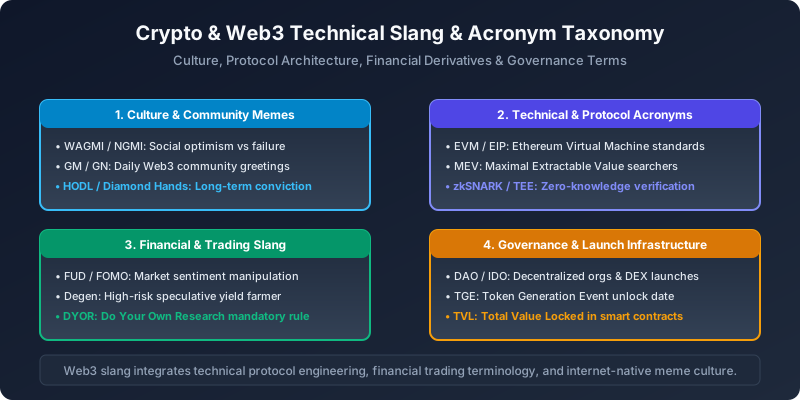
1. Cultural and Community Slang
Web3 is built on pseudonymous, global internet communities where shared terminology reinforces community trust, market optimism, and shared identity.
+-------------------------------------------------------------------+
|               Core Community & Cultural Terms                     |
+-------------------------------------------------------------------+
| WAGMI: We're All Gonna Make It (Collective market optimism)       |
| NGMI: Not Gonna Make It (Dismissal of poor decisions/skepticism)  |
| GM / GN: Good Morning / Good Night (Universal community greeting) |
| HODL: Hold On for Dear Life (Long-term asset conviction)          |
| Diamond Hands vs Paper Hands: Resilience vs Panic Selling         |
+-------------------------------------------------------------------+
WAGMI (We're All Gonna Make It)
An acronym expressing collective optimism and solidarity within the Web3 community. Originally popularized in fitness culture, it was adopted by crypto communities to celebrate technical milestones, successful protocol launches, or market rallies.
NGMI (Not Gonna Make It)
The inverse of WAGMI. Used to describe individuals, projects, or traditional financial institutions that demonstrate a fundamental lack of understanding regarding Web3 principles, make poor security choices, or exhibit paper-hands behavior during market downturns.
GM / GN (Good Morning / Good Night)
The universal greeting across Crypto Twitter and Discord communities. Regardless of a participant's local timezone, greeting others with "GM" serves as a cultural signal of active community participation and positive intent.
HODL (Hold On for Dear Life)
Originally stemming from a legendary drunken forum post on BitcoinTalk in December 2013 titled "I AM HODLING" (a typo for "holding"), HODL evolved into a retronym for "Hold On for Dear Life." It refers to an investment strategy of retaining digital assets through extreme market volatility rather than panic selling.
Diamond Hands vs Paper Hands
- Diamond Hands: Describes investors or community members who maintain their asset positions through severe market drawdowns, demonstrating high conviction in the long-term utility of the protocol.
- Paper Hands: Refers to investors who panic sell their tokens at the first sign of market volatility or price decline.
2. Technical Protocol and Infrastructure Acronyms
For developers building on public blockchains, understanding technical acronyms is necessary for navigating smart contract development and node infrastructure.
+-------------------------------------------------------------------+
|              Technical & Infrastructure Acronyms                 |
+-------------------------------------------------------------------+
| EVM: Ethereum Virtual Machine (Smart contract execution runtime)  |
| EIP / ERC: Ethereum Improvement Proposal / Request for Comment    |
| MEV: Maximal Extractable Value (Block space arbitrage extraction) |
| ZK / zkSNARK: Zero-Knowledge Succinct Non-Interactive Proof      |
| RPC: Remote Procedure Call (Node communication interface)         |
+-------------------------------------------------------------------+
EVM (Ethereum Virtual Machine)
The sandboxed 256-bit execution environment that executes smart contract bytecode across all Ethereum nodes. Layer 1 and Layer 2 blockchains that support EVM compatibility (such as Polygon, Arbitrum, Optimism, Avalanche C-Chain, and Base) allow developers to deploy Solidity smart contracts seamlessly across multiple networks.
EIP and ERC (Ethereum Improvement Proposals & Requests for Comment)
- EIP (Ethereum Improvement Proposal): A formal design document outlining proposed standards for the Ethereum platform, including core protocol updates, networking changes, and contract standards (e.g., EIP-1559).
- ERC (Ethereum Request for Comments): A sub-category of EIPs focusing specifically on application-level token standards (e.g., ERC-20 for fungible tokens, ERC-721 for NFTs, and ERC-4626 for yield vaults).
MEV (Maximal Extractable Value)
Formerly known as Miner Extractable Value, MEV refers to the maximum value that can be extracted from block production over and above standard block rewards and gas fees by arbitrarily including, excluding, or reordering transactions within a block. MEV searchers use automated bots to execute arbitrage, front-running, and sandwich attacks on pending mempool transactions.
ZK and zkSNARK (Zero-Knowledge Proofs)
- ZK (Zero-Knowledge): A cryptographic method allowing one party (the prover) to prove mathematically to another party (the verifier) that a statement is true without revealing any underlying sensitive information.
- zkSNARK: Zero-Knowledge Succinct Non-Interactive Argument of Knowledge. A specific form of ZK proof characterized by small proof sizes and near-instant verification times, used extensively in zk-Rollup Layer 2 scaling solutions (such as zkSync, Starknet, and Linea).
3. Financial and Trading Terminology
DeFi and crypto trading ecosystems use specific financial metrics and speculative terms.
+-------------------------------------------------------------------+
|                Financial & Trading Slang Glossary                 |
+-------------------------------------------------------------------+
| TVL: Total Value Locked (Aggregate capital in smart contracts)    |
| FDV: Fully Diluted Valuation (Total market cap at 100% token supply)|
| FUD: Fear, Uncertainty, and Doubt (Market disinformation)         |
| FOMO: Fear Of Missing Out (Impulsive speculative buying)          |
| Degen: Degenerate (High-risk speculative trader or liquidity farm)|
+-------------------------------------------------------------------+
TVL (Total Value Locked)
The total dollar value of digital assets deposited as collateral inside a Decentralized Finance (DeFi) protocol's smart contracts (such as lending pools, automated market makers, or staking vaults). TVL serves as a primary metric for assessing protocol adoption, liquidity depth, and financial health.
FDV (Fully Diluted Valuation)
The theoretical total market capitalization of a cryptocurrency project if 100% of its maximum token supply were unlocked and in active circulation at current market prices ($\text{FDV} = \text{Current Token Price} \times \text{Max Token Supply}$). A project with a low circulating market cap but an extremely high FDV carries significant risk of future inflation dumps when vesting cliffs expire.
FUD (Fear, Uncertainty, and Doubt)
Disinformation, negative rumors, or exaggerated news spread intentionally to create market panic and depress the price of a digital asset.
FOMO (Fear Of Missing Out)
The psychological impulse that drives investors to buy an asset after its price has already surged significantly, driven by the anxiety of missing out on potential gains. FOMO often leads retail traders to buy at local market tops.
Degen (Degenerate)
Short for "degenerate gambler." In Web3 culture, "degen" is used self-referentially by traders and yield farmers who engage in high-risk speculative strategies, such as buying unedited meme tokens, providing liquidity to un-audited micro-cap pools, or trading with 50x margin borrowing.
4. Governance, Security, and Incident Terminology
Understanding terms related to protocol administration, smart contract security, and malicious exploits is vital for evaluating system risk.
+-------------------------------------------------------------------+
|              Governance & Security Slang Glossary                 |
+-------------------------------------------------------------------+
| DAO: Decentralized Autonomous Organization (On-chain voting)      |
| Rug Pull: Malicious team exit draining project liquidity pools     |
| Reentrancy Attack: Vulnerability where contract calls itself       |
| Timelock: Mandatory delay window before code changes execute     |
| Multisig: Wallet requiring multiple signatures (e.g. 3-of-5)     |
+-------------------------------------------------------------------+
DAO (Decentralized Autonomous Organization)
An organization governed by smart contracts where token holders vote weight-proportionally on protocol upgrades, treasury distributions, and strategic partnerships without central management.
Rug Pull
A malicious scam where project founders market a new token, attract retail capital into liquidity pools on a decentralized exchange, and then suddenly execute a function draining all pairing collateral (USDC or ETH) from the smart contract, leaving investors with worthless tokens.
Reentrancy Attack
A classic smart contract vulnerability where an attacking contract calls a vulnerable target contract's withdrawal function recursively before the target contract updates its internal state balance, allowing the attacker to drain the vault completely (the exploit behind the famous 2016 DAO hack).
Timelock Controller
A smart contract that enforces a mandatory delay window (such as 48 hours or 7 days) between when a DAO proposal passes on-chain and when the corresponding code execution occurs. Timelocks provide token holders with a warning window to inspect code or withdraw capital if a malicious proposal passes.
5. Comprehensive Web3 Slang and Acronym Dictionary
Below is an alphabetical reference table covering additional essential Web3 terms:
| Term / Acronym | Full Form / Context | Technical Definition |
|---|---|---|
| Ape In | Speculative Action | Buying heavily into a new token or NFT project without performing prior due diligence. |
| ATH / ATL | All-Time High / Low | The highest or lowest historical market price recorded for a specific digital asset. |
| Bridge | Cross-Chain Protocol | A smart contract protocol allowing users to transfer tokens between two distinct blockchains. |
| Burn | Supply Destruction | Permanently removing tokens from circulation by sending them to an un-spendable null address (0x000...000). |
| Cliff | Vesting Milestone | A mandatory period of time after a TGE before any vested tokens begin unlocking for team or seed investors. |
| DEX | Decentralized Exchange | A non-custodial peer-to-peer exchange (like Uniswap) operating via Automated Market Makers. |
| DYOR | Do Your Own Research | A foundational disclaimer advising individuals to independently evaluate code, whitepapers, and team backgrounds. |
| Gas War | Blockchain Congestion | A scenario where thousands of users compete to get transactions included in the next block by bidding high priority fees. |
| L1 / L2 | Layer 1 / Layer 2 | Layer 1 refers to base consensus chains (Ethereum, Bitcoin); Layer 2 refers to scaling execution networks (Arbitrum, Base). |
| NFT | Non-Fungible Token | Unique smart contract tokens (ERC-721) representing non-interchangeable digital property rights. |
| PFP | Profile Picture | NFT collections (such as CryptoPunks or Pudgy Penguins) designed primarily to serve as digital identity avatars. |
| Shilling | Aggressive Promotion | Promoting a cryptocurrency or NFT project in public forums with insincere enthusiasm for personal financial gain. |
| TGE | Token Generation Event | The exact timestamp when a smart contract mints its token supply and unlocks initial distributions. |
6. How Language Reflects Web3 Technical Culture
The terminology of Web3 is not arbitrary; it reflects the core ethos of decentralized computing:
+-------------------------------------------------------------------+
|               Philosophical Drivers of Web3 Language               |
+-------------------------------------------------------------------+
| 1. Don't Trust, Verify: Encapsulated by DYOR & On-Chain Audit     |
| 2. Self-Custody First: Reflected in "Not Your Keys, Not Your Coins"|
| 3. Permissionless Access: Open participation without gatekeepers  |
| 4. Memetic Coordination: Memes as viral social alignment tools   |
+-------------------------------------------------------------------+
Don't Trust, Verify
The foundational rule of cryptography. Web3 slang like DYOR and references to on-chain proofs emphasize that users should never rely on corporate claims. Every transaction, smart contract state, and supply schedule can be independently audited on public block explorers.
Not Your Keys, Not Your Coins
A timeless mantra reminding participants that assets held on centralized exchanges (CEXs) are subject to counterparty insolvency risks (as demonstrated by FTX and Celsius). True ownership requires holding assets in self-custodied non-custodial wallets where only you control the private key seed phrase.
Code is Law
A foundational smart contract philosophy stating that deployed on-chain EVM bytecode executes deterministically according to its written logic without discretionary human intervention, reversal, or censorship.
Hyper-Structure Mechanics
Coined by protocol architect Jacob Horne, a hyper-structure is an on-chain protocol that can run forever without maintenance, operates without intermediaries, is permissionless, is feature-complete, and provides a neutral public utility.
7. Frequently Asked Questions
What does "WAGMI" mean in Web3?
WAGMI stands for "We're All Gonna Make It." It is a motivational acronym used in Web3 and NFT communities to express collective optimism, solidarity, and encouragement during project launches or market cycles.
What is the difference between an L1 and an L2?
A Layer 1 (L1) is a base-layer blockchain (such as Ethereum, Bitcoin, or Solana) that maintains its own consensus engine and state validation. A Layer 2 (L2) is a scaling network (such as Arbitrum, Optimism, or zkSync) that executes transactions off-chain at lower fees and posts compressed state proofs back to the underlying Layer 1 for security.
What does "DYOR" mean and why is it used so frequently?
DYOR stands for "Do Your Own Research." It serves as a vital reminder that Web3 is a self-custodial, permissionless environment where investors and developers must independently audit smart contracts, tokenomics, and team backgrounds before committing capital or deploying code.
What is a "Rug Pull" in crypto?
A rug pull is a malicious scam where developers launch a new token project, attract retail capital into automated market maker liquidity pools on a decentralized exchange, and then abruptly drain the liquidity funds or execute hidden minting backdoors, abandoning the project.
What does "Apeing In" mean in crypto trading?
Apeing in refers to hastily purchasing a new cryptocurrency, token, or NFT collection immediately after launch without performing thorough due diligence, driven by social media hype and fear of missing out.
What is an "Alpha" group or "Alpha" call in Web3?
Alpha refers to valuable, non-public, or early-stage market information, investment opportunities, or technical insights that provide a competitive advantage before the broader public market becomes aware of them.
What does "Paper Hands" vs "Diamond Hands" mean?
Paper hands describes an investor who sells their digital assets at the first sign of market volatility or price declines. Diamond hands describes an investor who maintains their token positions through severe market drawdowns due to strong long-term conviction.
What is "Yield Farming" in DeFi?
Yield farming is the practice of depositing digital assets into decentralized lending protocols, automated market makers, or liquidity pools to earn interest, transaction fees, and native protocol token rewards.
What is a "Sybiled" Airdrop and what are Sybil attackers?
A Sybil attacker creates hundreds or thousands of automated wallet addresses to interact with a new protocol, attempting to farm a disproportionate share of a future token airdrop. Protocols use on-chain snapshot heuristics and identity verification tools (such as Gitcoin Passport) to filter out Sybil wallets.
What does "Flippening" mean in cryptocurrency markets?
The Flippening refers to a hypothetical market event where Ethereum's total market capitalization surpasses Bitcoin's total market capitalization, representing a major milestone in smart contract platform dominance.
What is an "Oracle" in smart contract development?
An oracle (such as Chainlink or Pyth) is a cryptographic data middleware service that fetches off-chain real-world data (such as asset prices, weather events, or sports scores) and submits it securely to on-chain smart contracts.
What is a "Slashing" penalty in Proof of Stake networks?
Slashing is an automated protocol punishment where a validator node loses a portion of its staked capital (e.g. staked ETH) and is permanently ejected from the network for behaving maliciously, such as double-signing conflicting block proposals or attesting to invalid chain histories.